
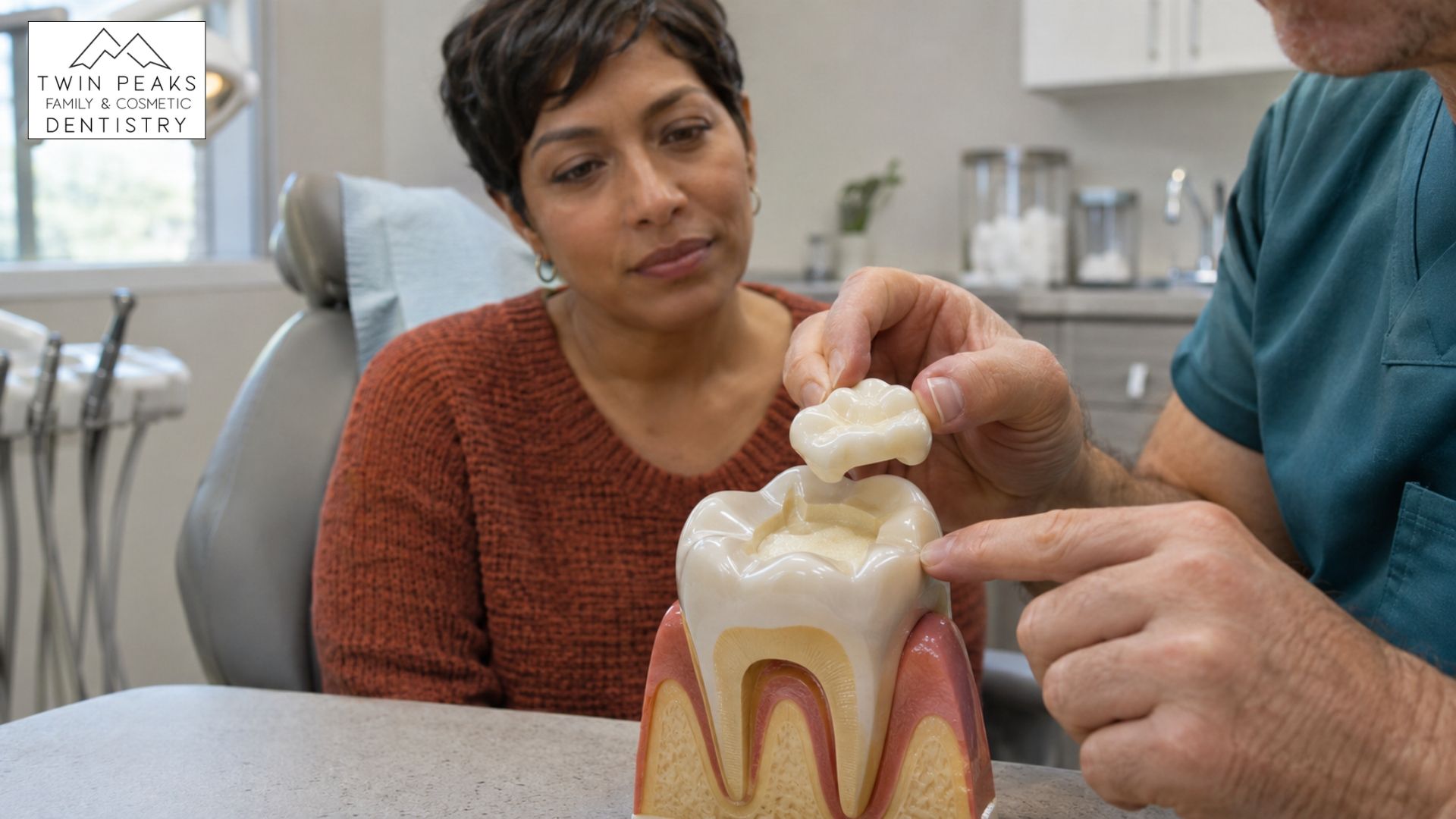
If a tooth needs restoration, your dentist may discuss an inlay, onlay, or crown. These options repair damaged tooth structure, but they cover different areas.
An inlay fits within the tooth’s cusps, an onlay covers one or more cusps, and a crown generally covers most or all of the prepared tooth above the gumline. Cusps are the raised portions of a back tooth’s chewing surface.
The recommended option depends on how much healthy tooth remains, where the damage is located, and how the tooth handles biting forces.
What Is the Difference Between an Inlay, Onlay, and Crown?
The main difference is coverage. An inlay stays within the cusps, an onlay extends over one or more cusps, and a crown provides broader coverage around the prepared tooth.
The American Dental Association’s glossary distinguishes restorations placed within a prepared cavity from onlays that cover cusp tips and adjoining chewing surfaces.
| Restoration | Typical Coverage | General Purpose |
| Inlay | Fits within the cusps without covering them | Restores a damaged area while retaining the cusps |
| Onlay | Covers one or more cusps | Restores areas requiring cusp coverage |
| Crown | Covers most or all of the prepared visible tooth | Provides more extensive coverage |
What Does an Inlay Cover?
An inlay fits into a prepared area without covering the cusps. It may be considered when the surrounding tooth structure can support this design.
An inlay is made outside the mouth and then fitted to the tooth. A direct filling is shaped in the tooth. Choosing between them involves more than measuring the damaged area.
What Does an Onlay Cover?
An onlay covers one or more cusps and the area being restored. It may be appropriate when a cusp needs coverage but other parts of the tooth can remain uncovered.
Your dentist assesses whether the remaining structure and proposed restoration can function predictably.
What Does a Crown Cover?
A crown fits over the prepared tooth, providing more extensive coverage around its visible portion.
Twin Peaks Dentistry’s fillings and crowns services offer background on these treatments. Ask which surfaces would be covered in your case.
How Does a Dentist Decide How Much Coverage Is Needed?
Your dentist assesses the remaining tooth structure, cusp condition, location of damage, existing dental work, and your bite.
A large old filling does not automatically mean a crown is necessary. Equally, a smaller-looking defect does not establish that an inlay provides enough coverage.
The assessment may include:
- How much healthy enamel and dentin remain
- Whether cusps are weakened or damaged
- The location and extent of decay or previous treatment
- The condition of existing restoration edges
- Biting forces and tooth-grinding habits
- Whether the restoration can be reliably bonded or cemented
Twin Peaks Dentistry’s restorative dentistry services in Longmont describe the broader options. An examination determines which applies to your tooth.
Why Preserving Healthy Structure Matters
An onlay may allow healthy surfaces to remain uncovered. However, preserving structure must be balanced with providing adequate coverage and a reliable restoration.
The goal is to match the design to the tooth’s needs, rather than automatically choosing the smallest or largest restoration.
What Should You Ask Before Choosing a Restoration?
Ask your dentist to show you which parts of the tooth need restoration and explain why the proposed coverage is appropriate.
Useful questions include:
- Which parts of my tooth are still healthy?
Ask what can remain and what needs preparation. - Do any cusps need coverage?
This helps explain whether an inlay or onlay may be suitable. - Could a partial restoration work here?
Ask why it is suitable or why broader coverage is recommended. - Which material are you recommending?
Discuss appearance, function, bonding, and cost. - What might change during treatment?
Removing decay or an old restoration may reveal additional damage.
This guide to explaining your dental goals to a new dentist can help you prepare.
Planning Visits From Niwot, Gunbarrel, or Berthoud
If you travel from Niwot, Gunbarrel, or Berthoud, contact the Twin Peaks Dentistry team about the expected appointment sequence. Confirm whether treatment involves a temporary restoration or a separate placement visit before arranging time away from work.
How Can Dr. Butler Explain the Coverage Your Tooth Needs?
Ask Dr. McKay Butler to point out the remaining tooth walls and cusps. Seeing which areas need restoration can make the difference between an onlay and crown easier to understand.
His stated philosophy is to “treat people, not teeth.” Explain your priorities, including preserving healthy structure, chewing comfortably, appearance, or managing appointments. Ask how those priorities fit with the findings and recommended coverage.
Planning Restorative Dental Care Around Veterans Day in Longmont
Veterans Day on November 11 honors those who served in the U.S. military. Veterans considering dental inlays, onlays, or crowns at Twin Peaks Family & Cosmetic Dentistry in Longmont, Colorado, can ask for a written explanation of the recommended restoration and estimated costs.
If you use VA benefits, review your eligibility for VA dental care and confirm authorization and provider requirements before scheduling. Coverage depends on your eligibility and approved benefits. Contact the dental office and your VA care team to clarify payment arrangements and any authorization needed.
Why Explain What Concerns You About Treatment?
You may hear “crown” and worry about tooth preparation, while someone else is concerned about chewing afterward.
In “Can You Feel What Your Patients Feel?” from Dental Marketing Secrets, Mark Thackeray discusses understanding the patient’s perspective. Explain the concern behind your questions so your dentist can address it alongside the clinical findings.
Frequently Asked Questions
Is an Onlay Bigger Than an Inlay?
An onlay extends over one or more cusps; an inlay does not. Coverage, rather than size alone, distinguishes them.
Does a Crown Cover More Tooth Than an Onlay?
Generally, yes. A crown surrounds more of the prepared tooth, while an onlay leaves some external surfaces uncovered.
How Do I Know Which Restoration I Need?
An examination is necessary. Your dentist considers the remaining structure, cusp condition, existing dental work, and bite.
Understand the Recommendation Before Treatment
For background, explore crowns and other smile-restoration options.
Request an appointment with Twin Peaks Family & Cosmetic Dentistry in Longmont to discuss how much coverage your tooth needs and why.